Guidelines recommend more than supportive therapy alone2
While supportive care therapies and lifestyle modifications may help, they do not target B cell activity, the immunologic source of IgAN, which leads to immune complex formation, proteinuria, hematuria, and potential kidney failure.3-5
TRUTAKNA is a rationally designed human TACI-Fc fusion protein6
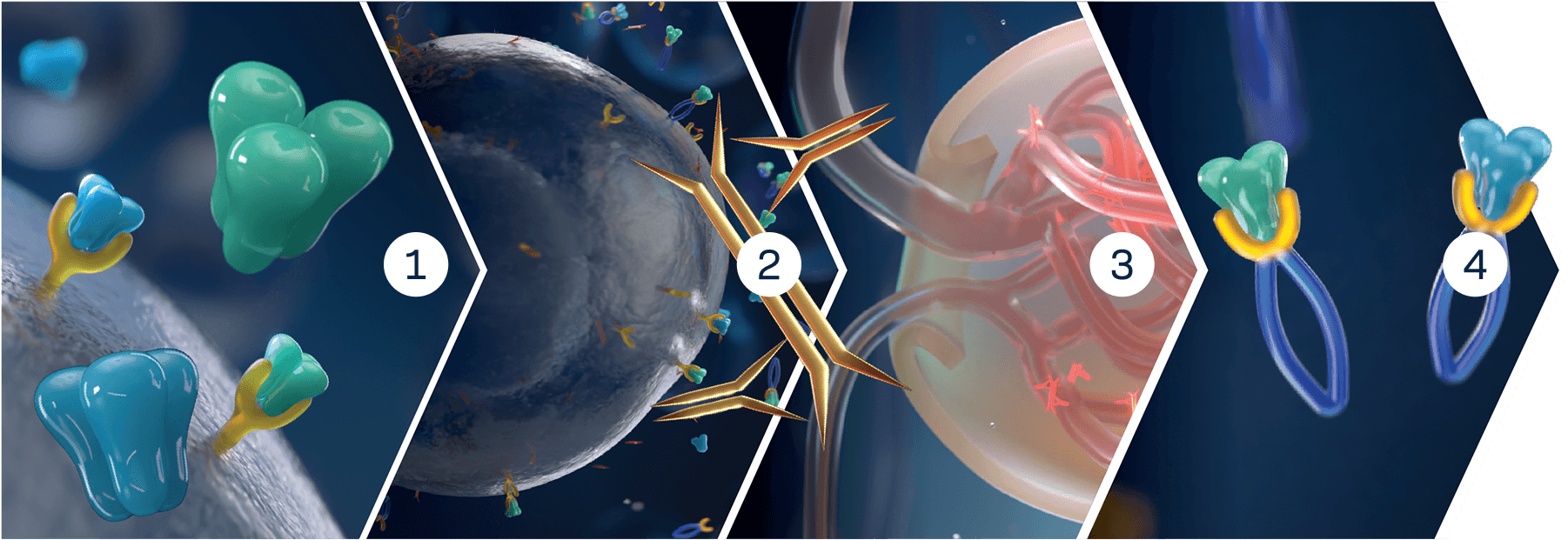
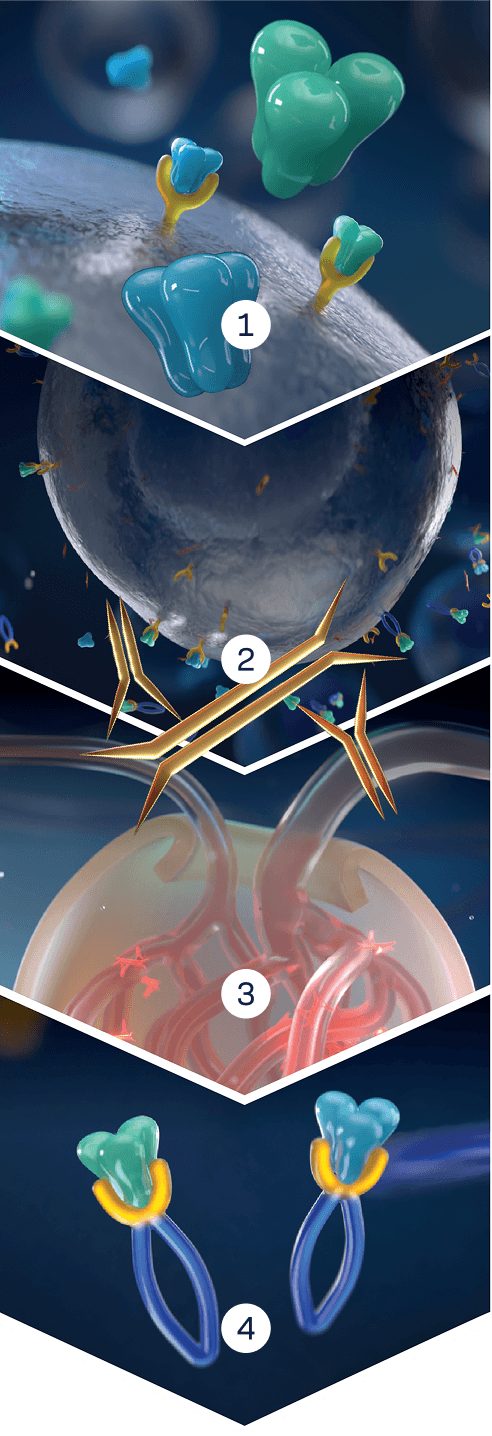
1
2
3
4
TRUTAKNA is designed to target the immunologic source of IgAN6
Take a closer look at how TRUTAKNA inhibits both upstream activators of disease and precisely modulates B cell activity.
Designed for precise B cell modulation6
TRUTAKNA appears to work without evidence of B cell depletion or broad immunosuppression
TRUTAKNA in a pivotal Phase 3 trial6
APRIL=A proliferation-inducing ligand; BAFF=B-cell activating factor; Gd-IgA1=galactose-deficient immunoglobulin A1; IgA=immunoglobulin A; IgAN=immunoglobulin A nephropathy; TACI=transmembrane activator and calcium modulator and cyclophilin ligand interactor.
IMPORTANT SAFETY INFORMATION AND INDICATION
INDICATION
TRUTAKNA (atacicept-vymj) is indicated to reduce proteinuria in adults with primary immunoglobulin A nephropathy (IgAN) at risk for disease progression.
This indication is approved under accelerated approval based on reduction of proteinuria. It has not been established whether TRUTAKNA slows kidney function decline over the long-term in patients with IgAN. Continued approval for this indication may be contingent upon verification and description of clinical benefit in a confirmatory clinical trial.
IMPORTANT SAFETY INFORMATION
CONTRAINDICATIONS
TRUTAKNA is contraindicated in patients with serious hypersensitivity to atacicept-vymj or any excipients of TRUTAKNA.
WARNINGS AND PRECAUTIONS
Immunosuppression and Increased Risk of Infections
TRUTAKNA suppresses the immune system by reducing antibody production, which may increase the risk of infections. Patients with chronic infection or recurring infections may have an increased risk of serious infection. In clinical trials, infections were reported in 32% of TRUTAKNA patients compared with 28% of placebo patients.
Before initiating TRUTAKNA, assess patients for active infections. Delay TRUTAKNA administration in patients with active infection until the infection resolves or is adequately treated. Monitor patients for signs and symptoms of infection during treatment with TRUTAKNA. If a serious infection develops, consider interrupting TRUTAKNA until the infection is controlled.
The concomitant use of TRUTAKNA and other immune-modulating therapies has not been evaluated. Concomitant use of TRUTAKNA with drugs that affect the immune system, including systemic corticosteroids, may increase the risk of infection.
Immunosuppression and Immunization Risk
TRUTAKNA may interfere with the immune response to vaccines and increase the risk of infection from live vaccines. Prior to initiating treatment with TRUTAKNA, complete all age-appropriate immunizations. Live vaccines are not recommended within 30 days prior to initiation or during treatment with TRUTAKNA as safety of coadministration has not been established.
ADVERSE REACTIONS
The most common adverse reactions (≥5%) in patients treated with TRUTAKNA and placebo, respectively, were infections (32% vs 28%) and local administration reactions (30% vs 5%). The most common infection was upper respiratory tract infection (12% vs 9%), and the most common local administration reactions were injection site reaction (19% vs 2%) and injection site erythema (6% vs 1%).
USE IN SPECIFIC POPULATIONS
Pregnancy
Available data on TRUTAKNA used in pregnant women exposed during clinical trials are insufficient to evaluate for a drug-associated risk of major birth defects, miscarriage, or other adverse maternal or fetal outcomes.
Based on the mechanism of action, TRUTAKNA may cause immunosuppression in the in utero-exposed infant. Consider the potential clinical impact of TRUTAKNA exposure in infants exposed in utero. Pregnant women exposed to TRUTAKNA, or their healthcare provider, should report TRUTAKNA exposure by calling 1-833-633-8372.
Pediatric Use
The safety and effectiveness of TRUTAKNA in pediatric patients have not been established.
You may report side effects to the FDA at 1-800-FDA-1088 or www.fda.gov/medwatch. You may also report side effects to Vera Therapeutics at 1-833-MED-VERA or medinfo@veratx.com.
Please see Important Safety Information throughout and Full Prescribing Information here.
References: 1. TRUTAKNA. Prescribing information. Vera Therapeutics; 2026. 2. Floege J, Barratt J, Cook HT, et al. Executive summary of the KDIGO 2025 Clinical Practice Guideline for the Management of Immunoglobulin A Nephropathy (IgAN) and Immunoglobulin A Vasculitis (IgAV). Kidney Int. 2025;108(4):548-554. doi:10.1016/j.kint.2025.04.003 3. Kwon CS, Daniele P, Forsythe A, Ngai C. A systematic literature review of the epidemiology, health-related quality of life impact, and economic burden of immunoglobulin A nephropathy. J Health Econ Outcomes Res. 2021;8(2):36-45. doi:10.36469/001c.26129 4. Cheung CK, Barratt J, Liew A, Zhang H, Tesar V, Lafayette R. The role of BAFF and APRIL in IgA nephropathy: pathogenic mechanisms and targeted therapies. Front Nephrol. 2024;3:1346769. doi:10.3389/fneph.2023.1346769 5. Kidney Disease: Improving Global Outcomes (KDIGO) IgAN and IgAV Work Group. KDIGO 2025 Clinical Practice Guideline for the Management of Immunoglobulin A Nephropathy (IgAN) and Immunoglobulin A Vasculitis (IgAV). Kidney Int. 2025;108(4S):S1-S71. 6. Lafayette R, Barbour SJ, Brenner RM, et al; ORIGIN Phase 3 Trial Investigators. A phase 3 trial of atacicept in patients with IgA nephropathy. N Engl J Med. 2026;394(7):647-657. doi:10.1056/NEJMoa2510198