HCP resources

TRUTAKNA HCP Brochure
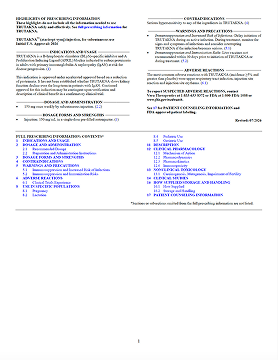
Prescribing
Information
Patient resources
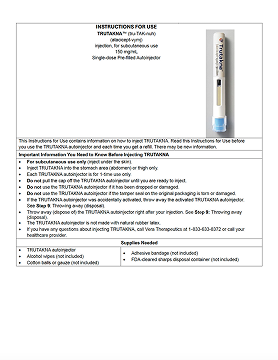
Instructions For Use

Patient Consideration Brochure
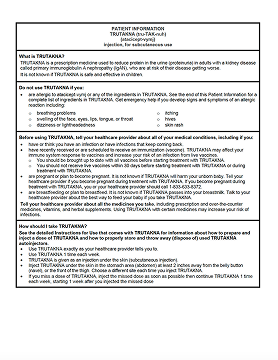
Patient Information
Video library


Organizations for IgAN*

The IgA Nephropathy Foundation is dedicated to finding a cure for IgAN and works to fund research, provide advocacy, and build a support network for those living with IgAN.
visit site
The National Kidney Foundation (NKF) is an organization dedicated to providing education for kidney health and support for those living with kidney diseases.
visit site
NephCure is working to improve access to care for people with rare, protein-spilling kidney diseases, including IgAN, through research, advocacy, and community-building.
visit site*
This is a partial list of advocacy organizations. Vera Therapeutics does not endorse any of the above organizations.
Request a TRUTAKNA representative
Learn more about this first-in-class BAFF and APRIL inhibitor in IgAN by requesting to connect with a TRUTAKNA representative2,3
Stay in the know about TRUTAKNA
Sign up to receive the latest on TRUTAKNA. These updates are intended for US healthcare professionals only
APRIL=A proliferation-inducing ligand; BAFF=B-cell activating factor; IgAN=immunoglobulin A nephropathy.

Support for your patients begins with Tru Support enrollment
There are 2 ways to enroll:
1
CoverMyMeds Portal
2
Fax
Visit trutaknatrusupport.com for additional information about getting your patients started on TRUTAKNA
Resources at a glance
Insurance coverage assistance
Receive guidance as you navigate the health insurance process for TRUTAKNA, including verification of benefits, as well as support with prior authorization, reauthorization, denials, and appeals
Financial resources
For eligible patients, help with accessing potential financial and coverage support options may be available
Patient support and resources*
Treatment administration education and resources are provided by dedicated Nurse Educators throughout your patients’ treatment journeys with TRUTAKNA
Potential financial assistance options
Tru Support Copay Program†
Eligible commercially insured patients may pay as little as $0 out of pocket for TRUTAKNA
Subject to annual maximum benefit. Restrictions apply
Patient Assistance Program‡
Through the Patient Assistance Program, patients who are uninsured or underinsured may be eligible to receive TRUTAKNA at no cost
Restrictions apply
Tru Support Bridge Program§
If patients have delays with insurance coverage, the Tru Support Bridge Program may be able to offer temporary access to TRUTAKNA
Restrictions apply

Access coverage resources for TRUTAKNA

Tru Support Brochure
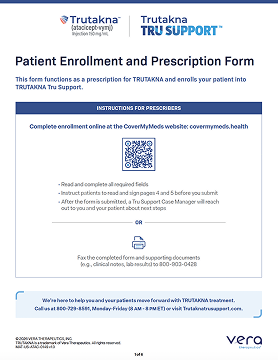
Tru Support Enrollment Form
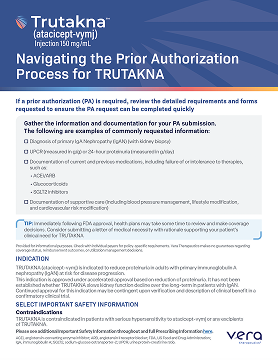
Prior Authorization Checklist
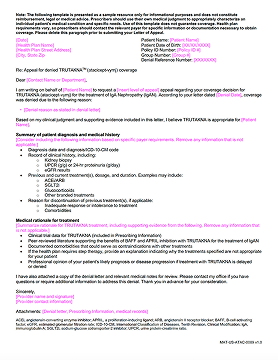
Sample Letter of Appeals Template
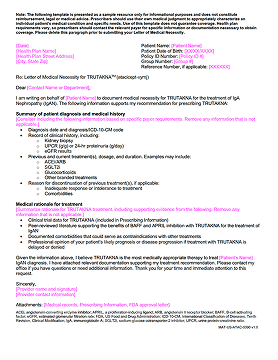
Sample Medical Necessity Letter
*
Nurse Educators provide education and support related to therapy initiation, administration, and available patient assistance resources. They do not provide clinical care or offer medical advice. All treatment decisions are determined by the healthcare provider.
†
Program is only valid for patients with commercial or private insurance. Patient must be a US resident. Program is not valid for patients insured by a federal or state government-funded health plan, including Medicare, Medicare Advantage, Medicaid, and TRICARE. Program is void where prohibited by law. Program does not cover the costs of any other healthcare provider charges or any other treatment costs. Patients are responsible for non–drug-related out-of-pocket costs. Additional eligibility requirements may apply. Vera Therapeutics reserves the right to terminate or modify this program at any time without notice.
‡
To qualify for the Patient Assistance Program, patients must complete an application, be a resident of the United States or of a US territory, have a valid prescription for TRUTAKNA, have no coverage/not enough coverage or insurance that doesn’t cover TRUTAKNA, meet annual household income threshold based on household size, and agree to and provide income verification. Not valid for prescriptions reimbursed in whole or in part by any government-funded program including but not limited to Medicare, Medicare Part D, Medicaid, Medigap, Veterans Affairs, Department of Defense, TRICARE, or any state, patient foundation, or other pharmaceutical program.
§
Bridge Program is not health insurance and is available for eligible, commercially insured patients only. Patient must be a US resident. No claim for reimbursement for product dispensed pursuant to this offer may be submitted to any third-party payer, additional insurer, or a patient’s state-sponsored commercial insurance. Not available to patients covered by a state or federal healthcare program, including but not limited to Medicare Part D, Medicaid, Medigap, Veterans Affairs, or Department of Defense or TRICARE programs. Bridge Program may be dispensed after primary coverage has been attempted and the patient is experiencing a delay in coverage. Available in a 28-day supply. Refills are subject to limitations and dispensing is at the sole discretion of Vera Therapeutics. To be eligible for an additional 28-day refill, the patient must be actively pursuing coverage through their insurance. Additional eligibility criteria may apply.
IMPORTANT SAFETY INFORMATION AND INDICATION
INDICATION
TRUTAKNA (atacicept-vymj) is indicated to reduce proteinuria in adults with primary immunoglobulin A nephropathy (IgAN) at risk for disease progression.
This indication is approved under accelerated approval based on reduction of proteinuria. It has not been established whether TRUTAKNA slows kidney function decline over the long-term in patients with IgAN. Continued approval for this indication may be contingent upon verification and description of clinical benefit in a confirmatory clinical trial.
IMPORTANT SAFETY INFORMATION
CONTRAINDICATIONS
TRUTAKNA is contraindicated in patients with serious hypersensitivity to atacicept-vymj or any excipients of TRUTAKNA.
WARNINGS AND PRECAUTIONS
Immunosuppression and Increased Risk of Infections
TRUTAKNA suppresses the immune system by reducing antibody production, which may increase the risk of infections. Patients with chronic infection or recurring infections may have an increased risk of serious infection. In clinical trials, infections were reported in 32% of TRUTAKNA patients compared with 28% of placebo patients.
Before initiating TRUTAKNA, assess patients for active infections. Delay TRUTAKNA administration in patients with active infection until the infection resolves or is adequately treated. Monitor patients for signs and symptoms of infection during treatment with TRUTAKNA. If a serious infection develops, consider interrupting TRUTAKNA until the infection is controlled.
The concomitant use of TRUTAKNA and other immune-modulating therapies has not been evaluated. Concomitant use of TRUTAKNA with drugs that affect the immune system, including systemic corticosteroids, may increase the risk of infection.
Immunosuppression and Immunization Risk
TRUTAKNA may interfere with the immune response to vaccines and increase the risk of infection from live vaccines. Prior to initiating treatment with TRUTAKNA, complete all age-appropriate immunizations. Live vaccines are not recommended within 30 days prior to initiation or during treatment with TRUTAKNA as safety of coadministration has not been established.
ADVERSE REACTIONS
The most common adverse reactions (≥5%) in patients treated with TRUTAKNA and placebo, respectively, were infections (32% vs 28%) and local administration reactions (30% vs 5%). The most common infection was upper respiratory tract infection (12% vs 9%), and the most common local administration reactions were injection site reaction (19% vs 2%) and injection site erythema (6% vs 1%).
USE IN SPECIFIC POPULATIONS
Pregnancy
Available data on TRUTAKNA used in pregnant women exposed during clinical trials are insufficient to evaluate for a drug-associated risk of major birth defects, miscarriage, or other adverse maternal or fetal outcomes.
Based on the mechanism of action, TRUTAKNA may cause immunosuppression in the in utero-exposed infant. Consider the potential clinical impact of TRUTAKNA exposure in infants exposed in utero. Pregnant women exposed to TRUTAKNA, or their healthcare provider, should report TRUTAKNA exposure by calling 1-833-633-8372.
Pediatric Use
The safety and effectiveness of TRUTAKNA in pediatric patients have not been established.
You may report side effects to the FDA at 1-800-FDA-1088 or www.fda.gov/medwatch. You may also report side effects to Vera Therapeutics at 1-833-MED-VERA or medinfo@veratx.com.
Please see Important Safety Information throughout and Full Prescribing Information here.
References: 1. Lafayette R, Barbour SJ, Brenner RM, et al; ORIGIN Phase 3 Trial Investigators. A phase 3 trial of atacicept in patients with IgA nephropathy. N Engl J Med. 2026;394(7):647-657. doi:10.1056/NEJMoa2510198 2. Cheung CK, Barratt J, Liew A, Zhang H, Tesar V, Lafayette R. The role of BAFF and APRIL in IgA nephropathy: pathogenic mechanisms and targeted therapies. Front Nephrol. 2024;3:1346769. doi:10.3389/fneph.2023.1346769 3. TRUTAKNA. Prescribing information. Vera Therapeutics; 2026.